Header


Phoebettmh Travel

Travel to anywhere, Travel Point, Travel tour list, Start Nowwww...

(Turkey) – Cappadocia - Land of fairy chimneys

Cappadocia; also Capadocia; Turkish Kapadokya, from Greek: Καππαδοκία / Kappadokía, Armenian: Կապադովկիա Kapadovkia, Persian: کاپادوکیه Kāpādōkiyeh) is a historical region in Central Anatolia, largely in Nevşehir Province.

(Turkey) - Cappadocia - Land of fairy chimneys


Cappadocia, a dreamy slice of central Turkey dotted with ‘fairy chimneys’ (rock formations), has a history every bit as remarkable as its landscape. Volcanic eruptions created this surreal moonscape: the lava flows formed tuff rock, which wind and rain sculpted into sinuous valleys with curvy cliff faces and pointy fairy chimneys. Cappadocians chiselled homes in the soft rock, paving the way for cave-dwelling hippies and today’s boutique fairy-chimney hotels.

(Turkey) - Cappadocia - Land of fairy chimneys

The area’s most extraordinary phase was during the medieval era, when the valleys were a refuge for Byzantine Christians. The religious troglodytes established monastic settlements, and their cave churches add a biblical solemnity to the Flintstones-like region. The Göreme Open-Air Museum, a World Heritage site, has the best collection of chapels and living quarters, most dating to around the 11th century.

(Turkey) - Cappadocia - Göreme Open Air Museum


Here are some must-see and must-dos while you’re in the area:

Byzantine frescoes

Despite centuries of weathering and vandalism, many of the frescoes (or more accurately seccos, painted on dry rather than wet plaster) are glorious, colourful sights. The Dark Church has the best examples: multicoloured angels cover the pillars and vaulted ceilings, along with scenes such as the birth of Jesus, with an ox and ass poking their noses into the manger. As the church’s name suggests, the lack of light has preserved the representations, which still look fresh and vivid after a millennium.

(Turkey) - Cappadocia - Land of fairy chimneys

Other monastic complexes nestle in the valleys, many recalling Star Wars backdrops (but don’t believe mischievous guides who claim Chewbacca was ever here). The most popular for a stroll is Ihlara Valley – filled with riverside greenery, birdsong and a string of churches cut into the base of towering cliffs.

(Turkey) - Cappadocia - Ihlara Valley

Explore underground cities

The local Christians were persecuted, first by the Romans and then raiding Muslims, and they often had to hide from hostile forces. When they heard hoof beats, they would abandon the cave churches and go underground – quite literally. Beneath Cappadocia’s rock formations is a network of subterranean cities, which housed up to 10,000 people each. The largest discovered are almost ten levels deep, with narrow passages connecting the floors like hamster tunnels.

(Turkey) - Cappadocia - Ihlara Valley

Touring the cities, you pass stables with handles used to tether the animals, churches with altars and baptism pools, walls with air circulation holes, granaries with grindstones and blackened kitchens with ovens. The ventilation shafts were disguised as wells, and chunky rolling-stone doors served as last lines of defence.  Not many artefacts remain – the inhabitants took their possessions when they returned to the surface – but the cities give a sense of life continuing in tough conditions.

(Turkey) - Cappadocia - Land of fairy chimneys

Live like a troglodyte

Staying in Cappadocia today doesn’t involve any hardship or subterranean chambers. Many cave dwellings and fairy-chimney chapels have been converted into boutique hotels, where you can try the troglodyte lifestyle in luxury. Features include cave hamams (Turkish baths), rock-cut arches, walls patterned with volcanic colour-banding and panoramic terraces surveying the valleys. You’ll quickly discover what the locals have known for centuries: the tuff rock keeps rooms cool in summer and warm in winter.

(Turkey) - Cappadocia - Land of fairy chimneys

The allure of tourist dollars has tempted many Cappadocians away from agriculture. The pigeon houses riddling the rock faces – traditionally used to collect the birds’ droppings for use as fertiliser – mostly stand empty. Nonetheless, village life continues and vestiges of the fabulous past remain – including the local wine. Cappadocia has one of the world’s oldest wine industries, which stretches back some 4000 years to the Hittites – the first to recognise the volcanic soil’s viticultural qualities, and to carve rock cellars. As you sample the Anatolian grape, there’s certainly a great deal of history to reflect on in this land of fairy chimneys and Byzantine remains.

(Turkey) - Cappadocia - Land of fairy chimneys

How to

Turkish Airlines flies from Istanbul to Nevşehir, Cappadocia. It also flies to nearby Kayseri from Istanbul, as does Anadolu Jet, while Pegasus Airlines flies from both Istanbul and Izmir and Sun Express flies from Germany. Daily buses from Istanbul take about 11 hours (normally overnight).

(Turkey) - Cappadocia - Land of fairy chimneys

Visit the churches and underground cities early in the morning, at midday or near closing to bypass the tour groups. Particularly at the underground cities, a guide is beneficial as they can explain what happened in the bare stone chambers.
(Wiki &Lonely Planet)
Read more

(France) – Visiting Château Gaillard, Normandy

At 40km from Rouen, Chateau Gaillard is a classified historic monument (classified in 1852) standing in impressive ruins above the village of Les Andelys in the Normandy countryside.

(France) – Château Gaillard, Normandy


Brief history of Chateau Gaillard

The castle was built by Richard the Lionheart over a two year period starting in 1196, to an unusual design that involved successive rings of moats and fortifications, making the inner keep almost impregnable.

(France) – Château Gaillard, Normandy


The castle had a colourful history through the Middle Ages, including a terrible siege in 1203 in which many hundreds died of hunger in the castle, as part of the wars between England and France at that time, and was won and changed hands between the English and French at various times during the Hundred Years War.

(France) – Château Gaillard, Normandy


Various sieges and imprisonments continued during the centuries that followed - including the imprisonment (and death) of the adulterous wife of Louis X. In 1417 the castle held out against a siege by the English for 16 months, eventually failing because the last rope that was being used to get water from the wells broke and they at last were forced to surrender.

(France) – Château Gaillard, Normandy


Largely abandoned the castle was already falling to ruin until Henry IV had it substantially destroyed in 1603 - for safety reasons rather than military reasons.

(France) – Château Gaillard, Normandy


Visiting Chateau Gaillard

The sunstantial ruins of the castle that remain are a romantic and evocative sight on the hill above Les Andelys village, with far reaching views over the Seine Valley, and are a highlight of a visit to the region.

(France) – Château Gaillard, Normandy


The original layout is still apparent, largely in the form of three defensive walls (the inner, middle and outer baileys) and the substantial keep inside the inner bailey. A particular innovation at gaillard was the use of machicolations* on the walls, a technique that substantially protected the soldiers in the castle from external attack and was virtually unknown in earlier castles.

(France) – Château Gaillard, Normandy


*The use of a 'stepped' wall around the top of the defences, so that soldiers could shoot from between sections of wall - like the top of the walls in a childs drawing of a castle.

(France) – Château Gaillard, Normandy


Visiting the castle you feel that you are walking in the footsteps of the kings and soldiers that have come before you, and Chateau Gaillard is a fascinating testament to the events that have taken place here. it also has nice views across the village below and surrounding countryside.

(France) – Château Gaillard, Normandy


(France) – Château Gaillard, Normandy


Suggested places to visit near Chateau Gaillard, France

- Lyons-la-Foret: 17km
- Giverny Gardens 21km
- La Roche-Guyon 24km
- Rouen 31km
- Evreux 32km
- La Bouille 37km
(France) - View of Château Gaillard to La Seine


- Gerberoy 45km
- Jumieges Abbey 48km
- Abbey of Bec-Hellouin 50km
- Beauvais 54km
- Villa Savoye 57km
- Caudebec-en-Caux 59km
(France This Way)
Phoebettmh Travel
Read more

(Russia) – Kamchatka – The land of true wilderness

Kamchatka is without exaggeration one of the most spectacular regions in Russia. It occupies the area of 470,000 sq. km, which equals the size of France, Belgium and Luxembourg combined, and separates the Sea of Okhotsk from the Pacific Ocean. One should not confuse Kamchatka with Siberia; this name is used for the peninsula itself and the closest part of the continent, including Karaginsky Island and the Komandorsky Archipelago. The mountain ridges - Sredinny, Valaginsky, Ganalsky and Kumroch - stretch from the north to the south giving the peninsula the shape of a giant fish. There are more than 160 volcanoes on the peninsula (29 of them are active), due to the fact that it lies on the Great Pacific “ring of fire”. Volcanoes and volcanic peaks, cyclones and underground heat created here a mixture of twenty climate zones and a great variety of flora and fauna. But the main attractions of Kamchatka are volcanic calderas, stone sculpture “parks” and lakes in craters, geysers and mineral springs, all in pristine condition.

(Russia) – Kamchatka – The land of true wilderness
The Cossack, Vladimir Atlasov, apparently "discovered" Kamchatka in 1697. He built two forts on the Kamchatka River, which became Russian trading camps. The native Koryak, Itelmen, Chukchi and Evens tribes were beaten down by these traders, and their population greatly diminished. Out of the few that remain, the Chukchi live in the northeast, Evens are in the central part of the peninsula and the Koryaks live on the west coast. They still live by traditional reindeer herding and sea fishing, which provide both food and clothing, and still preserve their culture and traditional lifestyles, which is the reason why one of the most remote regions is visited by so many people every year.

(Russia) – Kamchatka – The land of true wilderness

The famous marine explorer Vitus Y.Bering discovered it in 1740, when he chose the Avacha Bay as a base for sailing across the Pacific Ocean to the shores of future Russian America. From that time, Petropavlovsk was the main base for all subsequent round-the-world expeditions. The ships of Captain James Cook, La Perouse, I.F.Krusenstern, Captain Clark and other expeditions all visited Kamchatka.

(Russia) – Kamchatka – The land of true wilderness
Until the late 19th century, when the Imperial lands in Alaska were sold, Kamchatka was considered to be the least hospitable place in the Russian Empire. Nobody bothered visiting the region as it took six months to get there - only to face vast wilderness and a diminishing supply of fur. Around 1920, it nearly ended up in American hands. Washington Baker wanted to buy the province and was offered a 60-year concession by Lenin, but they couldn't agree on a deal.

(Russia) – Kamchatka – The land of true wilderness

Until 1990, no foreigners or nonresident Russians were allowed to visit. In 1991, the Russian Federation was established as an independent republic and Kamchatka was opened for visiting by foreign guests.

(Russia) – Kamchatka – The land of true wilderness

The main settlement of the peninsula and the capital of Kamchatka Region is the city of Petropavlovsk-Kamchatsky. The city is located on the southeastern shore of the Kamchatka Peninsula. Petropavlovsk's streets wind around green volcanic hills where city residents still pick berries and mushrooms. Covered with white snow, the peaks of Koryaksky, Avachinsky and Kozelsky volcanoes rise over them. And there are eternal moorage ribbons going along the Avacha Bay.

(Russia) – Kamchatka – The land of true wilderness

With a population of about 240,000 people, Petropavlovsk-Kamchatsky is an important port as well as a center of industry, science and adventure tourism.

(Russia) – Kamchatka – The land of true wilderness
 (Travel Kamchatka)
Read more

(France) – Giverny - Tips and tricks

Giverny is a small French village 80 km to the west of the capital city Paris, within the valley of the river Seine and the northern region of Upper Normandy. The village is best known as the rural retreat of the Impressionist painter Claude Monet (1840-1926).

(France) – Giverny  Garden
(France) – Giverny  Garden
Monet moved to Giverny in 1883 with his family, including his second wife and 8 children, living and painting here until his death in 1926. The village surroundings and the gardens of his house formed a great part of the inspiration and subject matter for his paintings. It was after the move to Giverny that Monet began his famous Séries of paintings, repeatedly rendering haystacks, cathedrals and waterlilies from his garden pond in his own unique Impressionist style.

(France) – Giverny  Garden
(France) – Giverny  Garden
What to see there

- Monet's House (Fondation Claude Monet), 84 rue Claude Monet, tel 02 32 51 28 21, open April-October Mo-Su 9:30 am - 6 pm, admission €8.00, €5.00 students, €4.00 disabled, under-7s free, wheelchair access available - e-tickets can now be purchased online to avoid queuing - the house is quietly eccentric and highly interesting in an Orient-influenced style, and includes Monet's collection of Japanese prints. There are no original Monet paintings on the site - the real drawcard, is the gardens around the house - the water garden with the Japanese bridge, weeping willows and waterlilies is now somewhat iconic. Monet's house has the obligatory gift-store attached, designed to help you part with your money in exchange for all manner of things Impressionist

(France) – Giverney Garden - Claude Monet's House

- The Musée des Impressionnismes Giverny , 99 rue Claude Monet, tel 02 32 51 94 65, open May - October Tu-Su 10 am - 6 pm, admission €6.50, €4.50 12-18s and students, €3 7-12s, under 7s free, wheelchair access available - the museum replaces the former Musée d'Art Américain. It proposes temporary exhibitions.
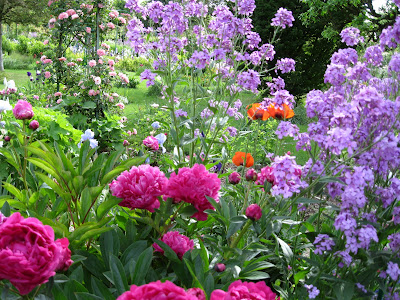
(France) – Giverny  Garden
(France) – Giverny  Garden
- The Natural Mechanical Museum, 2 rue Blanche Hoschedé-Monet, Phone: 02 32 21 26 33. 27620 Giverny. Association under 1901 law, founded by the Guillemard brothers: Jean-pierre, René and Gérard currently run restorations and exhibitions with the help of an enthusiasts team who devoted their time and known-how to the Patrimony preservation. The museum origin is a private collection of steam internal combustion engines; founded in 1955 by the Guillemard family a GIVERNY resident's since generations. Former threshing entrepreneur and blacksmith ADOLPHE Guillemard has transmitted to his children his know-how and passion for the vintage mechanies. Along years, purchasing, donations of engines pile-up awaiting for the needed parts or just a time to restore.

(France) – Giverny  Garden
(France) – Giverny  Garden


Since 1982 the number of collected items inereased due to closing of workshops, factories or mills. The preservation of these engines was a rescue task, numbers of testimonials items already gone. In 1990 the collection find home in the actual local where the engines are in permanent show, installation of the Carels 1908 diesel engine weighting 28 tons keep the team busy for months on overhauling and restoration; it becomes in 2003 the world bigger old running diesel engine.
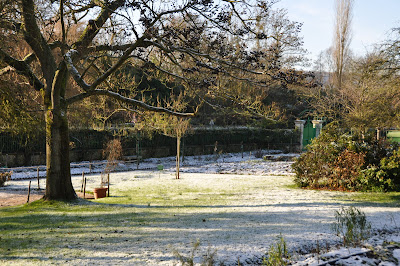
(France) – Giverny  Garden
(France) – Giverny  Garden

The best time to come to Monet’s
Monet's garden is incredibly beautiful from April to October. Flowers varieties are blooming one after another so that the garden changes gradually with the seasons while keeping its colors and brightness.

(France) – Giverny  Garden
(France) – Giverny  Garden

The peak period in frequentation is May-June, Summer is a bit more quiet and Automn very pleasant. In Summer you will enjoy the beauty of all annual flowers and of the famous Nympheas. In September and October the garden is a feast of giant flowers of splendid colors.
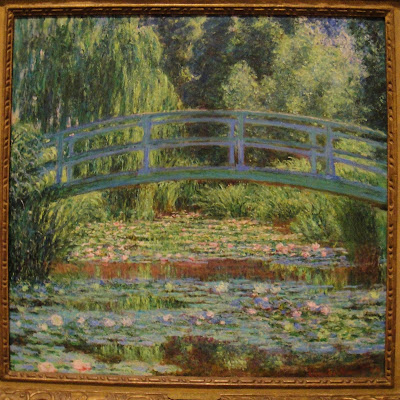
(France) – Giverny  Garden
(France) – Giverny  Garden

Giverny Monet’s garden

The Two Gardens
There are two parts in Monet's garden: a flower garden called Clos Normand in front of the house and a Japanese inspired water garden on the other side of the road. The two parts of Monet's garden contrast and complement one another.

(France) – Giverny  Garden
(France) – Giverny  Garden
The Clos Normand

When Monet and his family settled in Giverny in 1883 the  piece of land sloping gently down from the house to the road was planted with an orchard and enclosed by high stone walls.

(France) – Giverny  Garden
(France) – Giverny  Garden
A central alley bordered with pines separated it into two parts. Monet had the pines cut down, keeping only the two yews closest to the house to please Alice.

From this Clos Normand of about one hectare, Monet made a garden full of perspectives, symmetries and colours.

The land is divided into flowerbeds where flower clumps of different heights create volume. Fruit trees or ornamental trees dominate the climbing roses, the long -stemmed hollyhocks and the coloured banks of annuals. Monet mixed the simplest flowers (daisies and poppies) with the most rare varieties.

(France) – Giverny  Garden
(France) – Giverny  Garden
The central alley is covered over by iron arches on which climbing roses grow. Other rose trees cover the balustrade along the house. At the end of the summer nasturtiums invade the soil in the central alley.

Claude Monet did not like organized nor constrained gardens. He married flowers according to their colours and left them to grow rather freely.

With the passing years he developed a passion for botany, exchanging plants with his friends Clemenceau and Caillebotte.  Always on the look-out for rare varieties, he bought young plants at great expense. "All my money goes into my garden," he said. But also: "I am in raptures."

(France) – Giverny  Garden

The water garden

In 1893, ten years after his arrival at Giverny, Monet bought the piece of land neighbouring his property on the other side of the railway. It was crossed by a small brook, the Ru, which is a diversion of the Epte, a tributary of the Seine River. With the support of the prefecture, Monet had the first small pond dug ; even though his peasant neighbours were opposed. They were afraid that his strange plants would poison the water.

(France) – Giverny  Garden
(France) – Giverny  Garden

Later on the pond would be enlarged to its present day size. The water garden is full of asymmetries and curves. It is inspired by the Japanese gardens that Monet knew from the prints he collected avidly.
In this water garden you will find the famous Japanese bridge covered with wisterias, other smaller bridges, weeping willows, a bamboo wood and above all the famous nympheas which bloom all summer long. The pond and the surrounding vegetation form an enclosure separated from the surrounding countryside.

Never before had a painter so shaped his subjects in nature before painting them. And so he created his works twice. Monet would find his inspiration in this water garden for more than twenty years. After the Japanese bridge series, he would devote himself to the giant decorations of the Orangerie.

(France) – Giverny  Garden
(France) – Giverny  Garden

Always looking for mist and transparencies, Monet would dedicate himself less to flowers than to reflections in water, a kind of inverted world transfigured by the liquid element.

The Japanese bridge

Monet had it built by a local craftsman. By the time the garden was restored the bridge was too damaged to be saved. It had to be rebuilt by a firm from Vernon. It is made of beech wood.

(France) – Giverny  Garden
(France) – Giverny  Garden
The wisterias have been planted by Monet.

Visit

500 000 visitors discover Monet's gardens each year during the seven months that it is open.

To prevent people from treading on the plants, and thus retain the garden's beauty, the inner alleys are closed to the public. Visitors walk on the side alleys and can walk all around the garden to admire all its perspectives.

To get to the water garden you go through an underground passage (at the time of Monet it was necessary to cross the railway and the road). You will step on the Japanese bridge and explore all the hidden recesses of the water garden.

(France) – Giverny  Garden
(France) – Giverny  Garden

Taking pictures is permitted in the garden, but only from the walkways. Picnics are forbidden. Dogs and other pets are not admitted.

Restoring Monet's house and garden

After Claude Monet's death in 1926, his son Michel inherited the house and garden of Giverny. He did not live there and it was Monet's step-daughter Blanche who took care of the property. Unfortunately after the Second World War the house and garden were neglected. In 1966 Michel Monet made the Academie des Beaux-Arts his heir.

In 1977 Gérald van der Kemp was appointed Curator  at Giverny. André Devillers, who had the opportunity to go with Georges Truffaut - a distinguished gardener often invited to Monet's table - helped him reconstruct the garden as it was by the time of the master. Many contemporaries of Monet testified also.
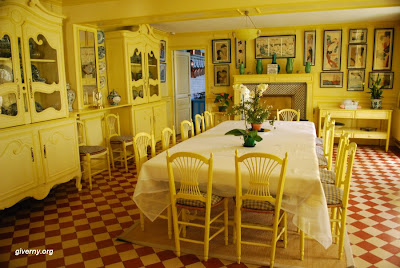
(France) – Cladue Monet's House - Dining Room

Almost ten years were necessary to restore the garden and the house their former magnificence. Not much was left. The greenhouse panes and the windows in the house were reduced to shards after the bombings. Floors and ceiling beams had rotted away,  a staircase had collapsed. Three trees were even growing in the big studio. 

The pond had to be dug again. In the Clos normand soil was removed to find the original ground level. Then the same flower species as those discovered by Monet in his time were planted.

Thanks to generous donors, mostly from the USA ,the house was given a facelift. The ancient furniture and the Japanese prints were restored. Then the visitor areas were fitted out.

The property has been open to the public since September 1980.
(Wiki Travel, Giverny)
Phoebettmh Travel
Read more

(Monaco) – Travelling to Monaco

The principality of Monaco or the city-state Monaco lies in between the Alps and the Mediterranean Sea, bounded by the French Riviera to the west and the Italian Riviera to the east.

(Monaco) – Travelling to Monaco
 
This is the second smallest independent state in the world (after the Vatican) and is almost entirely urban. Monte Carlo is not the capital of Monaco but a government district. The country is divided into four areas: Monaco-Ville (the old city), the Condamine (port quarter), Monte-Carlo (business and recreation), and Fontvieille (recreation and light industry). With no natural resources to exploit other than its location and climate, the principality has become a resort for tourists and a tax haven for businesses. Monaco is six times the size of the Vatican and the world's most densely populated independent country.

(Monaco) – Travelling to Monaco
 
The principality of Monaco offers a great balance of historical and modern attractions. There are various museums and palaces to visit as well as shopping malls and casinos. Monaco also offers relaxation spots along the harbor and even around the attractions. It is relatively easy to navigate Monte Carlo and Monaco if you take the time to learn where the various "short cuts" are. City maps are generally available at most news vendor stands and shops for a small fee.

(Monaco) – Travelling to Monaco
 
- Take a walk through Monaco-Ville, also known as “le rocher” or “the rock.” Monaco-Ville is still a medieval village at heart and an astonishingly picturesque site. It is made up almost entirely of pedestrian streets and passageways and most previous century houses still remain. There a number of hotels, restaurant and souvenir shops tourists can stay, eat and shop at. You can also visit the Prince's Palace, the Cathedral, the Oceanographic Museum, the City Hall, and the Saint Martin Gardens. 

(Monaco) – Travelling to Monaco
 - The Palais Princier (Prince's Palace) is in old Monaco-Ville and is worth a visit. There are guided tours of the palace each day and usually run around the clock. The Palace also offers a breathtaking panoramic view overlooking the Port and Monte-Carlo. Everyday at 11:55 AM, in front of the Palace's main entrance visitors can watch the changing of the guard ceremony performed by the "Carabiniers." “Carabiniers” are not only in charge of the Princes’ security but they offer Him a Guard of Honor and on special occasions, are His escorts. The “Compagnie des Carabiniers du Prince” has a military band (Fanfare); which performs at public concerts, official occasions, sports events and international military music festivals

(Monaco) - Palais Princier
- The Monaco Cathedral was built in 1875 and stands on the site of a 13th century earlier church. It is a Romanesque-Byzantine church dedicated to Saint Nicolas and houses the remains of former Princes of Monaco and Princess Grace. The church square also contains some of Monaco-Ville's finest restaurants.

(Monaco) - Monaco Cathedral
- The Oceanographic Museum and Aquarium is a world-renowned attraction. Located 279 above sea level, the museum contains stunning collections of marine fauna, numerous specimens of sea creatures (stuffed or in skeleton form), models of Prince Albert’s laboratory ships, and craft ware made from the sea’s natural products.

(Monaco) - Oceanographic Museum and Aquarium
On the ground floor, exhibitions and film projections are presented daily in the Conference room. In the basement, visitors can take pleasure in watching spectacular shows of marine flora and fauna. With 4,000 species of fish and over 200 families of invertebrates, the aquarium is now an authority on the presentation of the Mediterranean and tropical marine ecosystem. Lastly, visitors can have lunch in “La Terrasse” and visit the museum gift shop. The entrance fee is 15€ for adults. Students can get discount by showing valid student ID. You need to take bus number 1 or 2 from the Monaco Monte Carlo train station to reach this aquarium.

(Monaco) - Oceanographic Museum and Aquarium
 - The Jardin Exotique (Exotic Gardens) is one of the many gardens Monaco has to offer. It is also one of Monaco’s finest tourist attractions. Several thousand rare plants from around the world are presented in a walking tour that is quite memorable for the views as well as the flora and plants. Due to the rise in altitude, not only are there many displays of desert plants but there are a handful of subtropical flora displays as well. There is also a grotto (cave) that has scheduled guided tours. The tour starts at the beginning of every hour and lasts for around 25 minutes. In the cave, you will have to climb the stairs equivalent to around a 6 storied building. The entry cost is a bit steep (€8) unless you're under 16 or a student (€3.50). You need to take bus number 2 to reach this Garden. You can take this bus either from the train station or from the Oceanographic Museum

(Monaco) - Jardin Exotique
 - La Condamine is the second oldest district in Monaco, after Monaco-Ville. Here you can stop and marvel at the many luxurious yachts and cruise ships which usually adorn the docks in the marina. La Condamine is a thriving business district where you can visit the Condamine Market and rue Princesse-Caroline mall. With enjoyable landscaped areas and modern buildings, La Condamine is surely worth a visit

(Monaco) - La Condamine
 - The Monaco Opera House or Salle Garnier was built by the famous architect Charles Garnier. The auditorium of the opera house is decorated in red and gold and has frescoes and sculptures all around the auditorium. Looking up to the ceiling of the auditorium, the visitor will be blown away by the superb paintings. The opera house is flamboyant but at the same time very beautiful. There have been some of the most superior international performances of ballet, opera and concerts held in the opera house for more than a century; consider taking in a show during your visit... but expect to pay top dollar

(Monaco) - The Monaco Opera House

- The Marlborough Fine Arts Gallery was founded in London by Frank Lloyd and Harry Fischer. A second gallery was opened in Rome, another in New York, and one more in Monaco. The gallery holds a grand collection of post-World War II artists and even paintings by Pablo Picasso, Joan Miró, Jules Brassai, Louise Bourgeois, Dale Chihuly, David Hockney and Henri Matisse. Admission is free and the gallery also offers group exhibitions.

- The Grimaldi Forum is the Monaco convention center. Completed in July 2000, the sun filled building on the sea has a remarkable glass entrance, two convention restaurants, an auditorium for ballet and opera, and two more auditoriums for meetings and other affairs.

(Monaco) - Grimaldi Forum

The Forum also offers two large exhibition halls that can be used for trade shows or other exhibitions. It is also a short walking distance from surrounding hotels.

(Monaco) - Grimaldi Forum

- The Princes car collection For any car enthusiast, it is the place to go, there is everything, from carriges and old cars, to formula 1 race cars.

(Monaco) - Princes car collection
(Wiki Travel)
Read more